
By Hugh Locke, Guest blogger
Regenerative agriculture has arrived. What began as an outsider methodology practiced by pioneering farmers and championed by a handful of advocacy organizations has become one of the defining climate strategies of our time.
During Climate Week NYC in September 2025, regenerative agriculture was featured in roughly one hundred events out of more than nine hundred total, putting it among the five most discussed topics alongside artificial intelligence and energy transition. At COP30 in Brazil, twenty-seven dedicated sessions addressed regenerative agriculture, and Brazil launched the RAIZ Initiative, an ambitious global effort to restore 1.5 billion hectares of degraded agricultural land through regenerative practices. The question is no longer whether regenerative agriculture will reshape global food systems. The question is what we include – and what we leave out – as the movement's boundaries are defined.
There is one significant omission in how regenerative agriculture is currently being framed that deserves urgent attention: the role of trees.
A Movement Missing Its Forest
Walk through the program of any major regenerative agriculture conference and you will encounter cover cropping, reduced tillage, diverse rotations, and integrated livestock management. These are the pillars of the movement as it is typically taught and measured.
What you are less likely to find is sustained, serious attention to trees as essential components of regenerative farming systems, particularly for the hundreds of millions of smallholder farmers in the Global South who cultivate a large portion of the world's food on plots of two hectares or less.
This is a remarkable gap.
Trees provide some of the most powerful regenerative benefits available to any farming system: deep-rooting carbon sequestration, nitrogen fixation, erosion control, biodiversity corridors, microclimate moderation, and long-term soil structure. In tropical and subtropical contexts, precisely where most smallholder farmers live and work, the integration of trees into agricultural landscapes is not supplementary. And yes, trees are among the “perennial crops” associated with regenerative methodology, but they are not considered foundational for the most part.
Meanwhile, the tree planting and reforestation sector has been undergoing its own profound transformation. Satellite imagery and artificial intelligence now enable monitoring of individual trees from space and near real-time verification of outcomes. Carbon credit markets have created financial mechanisms connecting forest protection to corporate purchasing commitments. National-scale forest protection programs are mobilizing hundreds of millions of dollars. Investment funds focused on nature-based solutions are deploying capital at scales that dwarf traditional philanthropic funding.
Two of the most powerful climate solutions of our era are regenerative agriculture and forest restoration, and they are evolving rapidly, but largely in parallel. They relate to the same landscapes, the same smallholder farmers, and the same urgent timeline. Yet they have not been formally brought together.
That is the opportunity regenerative agroforestry represents.
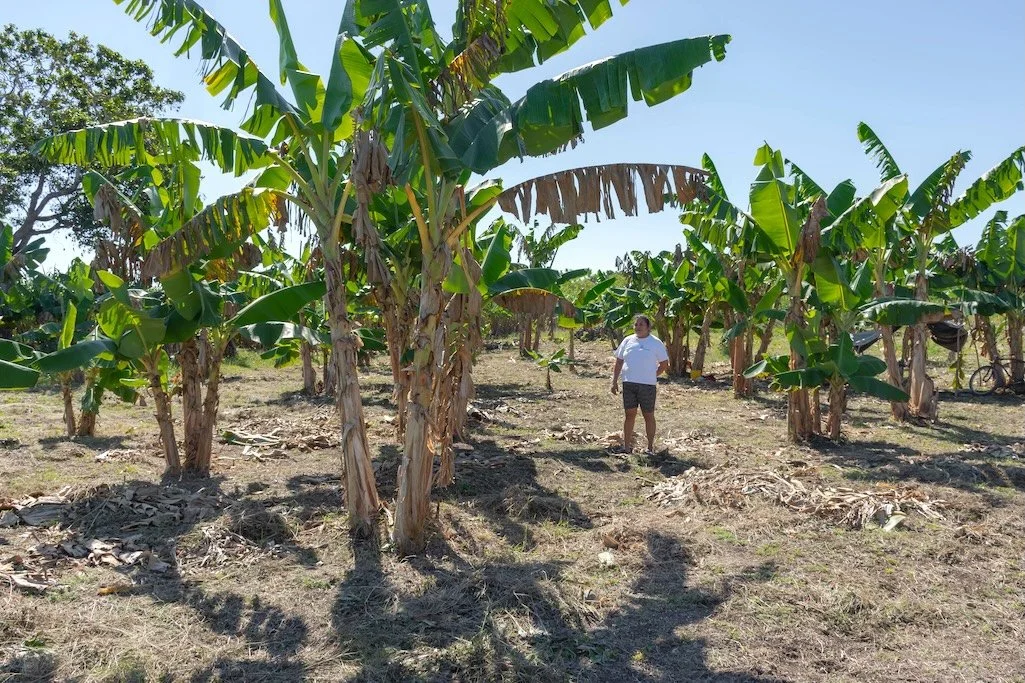
Caption: Mrs. Rubiceli Victorin in her agroforestry system. SHI works with farmers to incorporate diversified crops, including trees, in the participant’s farming system. Our trainers also work with family farmers to learn and manage agroforestry as a way to mitigate climate change and improve their economic resilience, by protecting their land’s productivity and diversifying the crops they produce for sale.
Agroforestry as the Bridge
Regenerative agroforestry integrates trees into farming systems in ways that restore soil health, enhance biodiversity, sequester carbon, and improve farmer livelihoods simultaneously. It involves designing systems where trees, crops, and sometimes livestock interact synergistically: the trees provide shade, fix nitrogen, prevent erosion, and create microclimates, while the crops provide ground cover and near-term economic returns as the trees mature. The combined system becomes more resilient and more regenerative than either trees or crops managed independently.
For smallholder farmers, this integration is particularly powerful.
A farmer who plants trees alongside their crops is not choosing between food production and environmental stewardship. They are doing both at once, often on land where trees once grew before the pressures of population, poverty, and market demand stripped them away.
Regenerative agroforestry is not a new idea imposed from outside; it draws on traditional farming knowledge from across the Global South that industrial agriculture systematically displaced.
What is new is the infrastructure now available to support it. Satellite monitoring capabilities, rigorous carbon credit methodologies, corporate supply chain commitments, and national forest programs have created verification and finance systems that can make regenerative agroforestry economically viable at scale.
But smallholder farmers in developing countries typically cannot access these mechanisms without connection to frameworks that the broader regenerative agriculture movement is building. Being formally included in how regenerative agriculture defines itself is not a symbolic gesture. It is a gateway to real resources.
The Window Is Now
The regenerative agriculture movement is still young enough that its boundaries remain flexible and negotiable. Establishing regenerative agroforestry as a formally recognized category within the movement – with its own criteria, metrics, and pathway to finance – is achievable right now in a way it may not be once the field consolidates.
The urgency extends beyond process. Climate impacts are accelerating on the farms of smallholder families who are least responsible for the emissions driving those impacts.
The farmers who most need access to the resources, recognition, and resilience generated by the regenerative agriculture movement are often the same farmers whose traditional agroforestry knowledge holds some of the most powerful answers to the questions the movement is trying to solve.
Regenerative agriculture has achieved critical mass. Forest restoration is being rebuilt around new technologies, finance mechanisms, and verification systems. The convergence of these two trajectories through smallholder regenerative agroforestry becoming a recognized category within the broader movement is one of the most promising and underexplored opportunities in global climate action today.
Trees belong in this story. And the smallholder farmers who have always known how to grow them alongside their crops deserve to be at its center.
Hugh Locke is President of the Impact Farming Foundation and Co-Founder of the Smallholder Farmers Alliance in Haiti. He serves on the board of One Tree Planted.
